(Continued from Part 3)
Another point to remember is that China is an emerging economy whilst USA's is a developed economy. China is seen to 'emerge' because it is still in transition from a planned economy to a more market economy, and by doing so it has taken on economic reforms and policies that support development, as discussed in Parts 1 and 2.
Being an emerging market, China would receive more FDI than USA, and it is interesting to note that much of it comes from the USA, about $60.5 billion in 2010. USA, being a developed economy, would normally receive less transfers and FDIs - China's FDI in the USA was only $3.2 billion in 2010. Besides that, the population growth in China, most startlingly, was 0.48% compared to USA's 0.9% in 2012. Although the rate population growth is usually higher in developing and emerging economies, in China's case, I think it is urbanisation that really counts (discussed at the end of this paragraph). Lastly, the transition from an agricultural economy to a more industry and service based economy is still an ongoing process in China, with many millions from the rural areas in China migrating to urban areas every year, with a rate of 2.3% between 2010 to 2015.
Therefore, as of 2012, China remains the second largest economy in the world, not because it does not have the capacity to but because it is still emerging and transitioning. Some predict China will overtake the USA to become the largest economy in the world by the end of this year, while some say by 2015. Then there are also those who are worried about the Chinese economy imploding the way Japan's did about 2 decades ago. In my opinion, China's rise to become a leader in manufacturing seems inevitable, but for how long China can remain in the number 1 spot is anyone's bet.
Cheers
zhusun
Further reading:
https://www.cia.gov/library/publications/the-world-factbook/geos/us.html
https://www.cia.gov/library/publications/the-world-factbook/geos/ch.html
http://www.ustr.gov/countries-regions/china
Showing posts with label China. Show all posts
Showing posts with label China. Show all posts
Friday, 29 March 2013

China, the Manufacturing Capital of the World... to-be (Part 3)
(Continued from Part 2)
For 33 years since 1979, China had grown at an average of 9.9% a year. It is estimated that China's GDP expanded by 7.8% in 2012. China is also the largest exporter of goods to the USA, totaling $399.3 billion in 2011. Its exports in 2012 totaled $2.021 trillion and a labour force of 795.4 million. When talking about China, it seems that everything is in big proportions.
With all the impressive statistics, the title of this series of blog posts may be questionable, if not unsuitable. Coupled with the hype surrounding China's ability to become a manufacturing powerhouse in such a short time, it is easy to overlook other statistics.
It is important to remember that manufacturing in the USA is not, well, dead. With the advent of whole manufacturing communities becoming 'rust belts' since the 1980's, it is easy to assume that USA has grown out of the industry. But removing manufacturing from USA is near impossible. Some are talking about a revival in manufacturing. The cities leading in this revival include Seattle, Salt Lake City and Austin in Texas. Manufacturing in USA is still very much alive. Only, now the focus is directed more towards R&D and producing high value added products.
Last year, the real GDP growth of USA was only an estimated 2.2%. Compare that with China's growth, it is unenviable. However, economic growth rate is just one part of the comparison. There are other measures which would make the reason why China is not yet the largest economy and the manufacturing capital on earth.
Most noteworthy is the difference in Purchasing Power Parity (PPP) between China and USA. The definition of PPP provided by Investopedia, is the estimated amount of adjustment needed on the exchange of countries so that the exchange is equivalent to each county's purchasing power. Last year, China's PPP was $12.28 trillion while USA's was $15.66 trillion. Additionally, China's GDP in official exchange rate was $8.25 trillion while USA's was $15.65 trillion. Considering China's exchange rate is said to be very much depressed, $8.25 trillion is a lot! Hence, although China's manufacturing sector is expanding at an incredible rate, it still has not overtaken USA's.
(To be concluded in Part 4)
Cheers
zhusun
Further reading:
https://www.cia.gov/library/publications/the-world-factbook/geos/ch.html
https://www.cia.gov/library/publications/the-world-factbook/geos/us.html
http://www.investopedia.com/terms/p/ppp.asp
http://www.ustr.gov/countries-regions/china
http://www.forbes.com/sites/joelkotkin/2012/05/24/seattle-is-leading-an-american-manufacturing-revival/
For 33 years since 1979, China had grown at an average of 9.9% a year. It is estimated that China's GDP expanded by 7.8% in 2012. China is also the largest exporter of goods to the USA, totaling $399.3 billion in 2011. Its exports in 2012 totaled $2.021 trillion and a labour force of 795.4 million. When talking about China, it seems that everything is in big proportions.
With all the impressive statistics, the title of this series of blog posts may be questionable, if not unsuitable. Coupled with the hype surrounding China's ability to become a manufacturing powerhouse in such a short time, it is easy to overlook other statistics.
It is important to remember that manufacturing in the USA is not, well, dead. With the advent of whole manufacturing communities becoming 'rust belts' since the 1980's, it is easy to assume that USA has grown out of the industry. But removing manufacturing from USA is near impossible. Some are talking about a revival in manufacturing. The cities leading in this revival include Seattle, Salt Lake City and Austin in Texas. Manufacturing in USA is still very much alive. Only, now the focus is directed more towards R&D and producing high value added products.
Last year, the real GDP growth of USA was only an estimated 2.2%. Compare that with China's growth, it is unenviable. However, economic growth rate is just one part of the comparison. There are other measures which would make the reason why China is not yet the largest economy and the manufacturing capital on earth.
Most noteworthy is the difference in Purchasing Power Parity (PPP) between China and USA. The definition of PPP provided by Investopedia, is the estimated amount of adjustment needed on the exchange of countries so that the exchange is equivalent to each county's purchasing power. Last year, China's PPP was $12.28 trillion while USA's was $15.66 trillion. Additionally, China's GDP in official exchange rate was $8.25 trillion while USA's was $15.65 trillion. Considering China's exchange rate is said to be very much depressed, $8.25 trillion is a lot! Hence, although China's manufacturing sector is expanding at an incredible rate, it still has not overtaken USA's.
(To be concluded in Part 4)
Cheers
zhusun
Further reading:
https://www.cia.gov/library/publications/the-world-factbook/geos/ch.html
https://www.cia.gov/library/publications/the-world-factbook/geos/us.html
http://www.investopedia.com/terms/p/ppp.asp
http://www.ustr.gov/countries-regions/china
http://www.forbes.com/sites/joelkotkin/2012/05/24/seattle-is-leading-an-american-manufacturing-revival/
Tuesday, 19 February 2013
China, the Manufacturing Capital of the World... to-be (Part 2)
(Continued from Part 1)
In 1978, China underwent widespread economic reforms. The government relaxed on investment policies, encouraged foreign investment and private-ownership. These reforms were initiated by the Communist Party of China, at the time time led by Deng Xiaoping. The reforms comprised of two stages. In the first stage, the government opened China up to foreign investment, encouraged more entrepreneurial activities by permitting more business start-ups and decollectivising agriculture. In the second stage, many state-owned industries were privatised, lifting of price controls and abolishing protectionist policies and regulations. The result of the economics reforms was a new economic climate which was more competitive, productive and dynamic.
Then came the time known as the 'readjustment period', from 1979 to 1981. Its agenda included stimulating agricultural production, expanding exports and overcoming logistics and electrical power issues. Policies were first introduced by the government experimentally on a small scale. If proven effective and successful then the policy would be applied on a large scale.
In agriculture, an interesting policy called the 'contract responsibility system' or 'household contract responsibility system', that would allow farmers to own and work a small piece if land. The farmers were motivated to produce more and cut costs because they would keep the profits earned.
Besides that, policies that encouraged innovation and competition were also introduced to the industry. Enterprises could be collectively owned or individually owned, which was significant because during the Cultural Revolution, individual enterprises were almost non-existent.
Most importantly, foreign trade was very much encouraged. From easing foreign trade procedures to legalising interactions with foreign firms in China, systematic steps were taken to prepare China for the world stage once again. International trade would become a very important aspect in China's rise to become the manufacturing capital of the world.
(To be continued in Part 3)
Cheers
zhusun
Further reading:
http://en.wikipedia.org/wiki/Economic_history_of_the_People%27s_Republic_of_China#Reform_of_the_economic_system.2C_beginning_in_1978
http://english.cri.cn/3126/2008/10/31/53s419817.htm
In 1978, China underwent widespread economic reforms. The government relaxed on investment policies, encouraged foreign investment and private-ownership. These reforms were initiated by the Communist Party of China, at the time time led by Deng Xiaoping. The reforms comprised of two stages. In the first stage, the government opened China up to foreign investment, encouraged more entrepreneurial activities by permitting more business start-ups and decollectivising agriculture. In the second stage, many state-owned industries were privatised, lifting of price controls and abolishing protectionist policies and regulations. The result of the economics reforms was a new economic climate which was more competitive, productive and dynamic.
Then came the time known as the 'readjustment period', from 1979 to 1981. Its agenda included stimulating agricultural production, expanding exports and overcoming logistics and electrical power issues. Policies were first introduced by the government experimentally on a small scale. If proven effective and successful then the policy would be applied on a large scale.
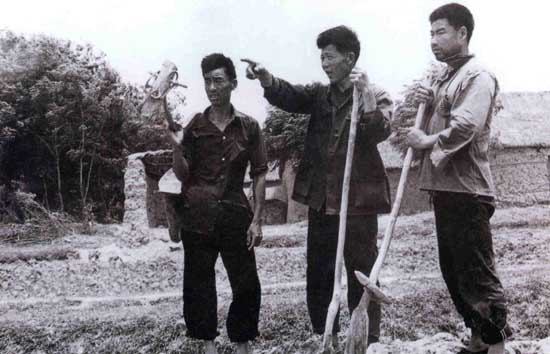 |
| Farmers in China (Source: http://english.people.com.cn/90002/95589/6512380.html) |
Besides that, policies that encouraged innovation and competition were also introduced to the industry. Enterprises could be collectively owned or individually owned, which was significant because during the Cultural Revolution, individual enterprises were almost non-existent.
Most importantly, foreign trade was very much encouraged. From easing foreign trade procedures to legalising interactions with foreign firms in China, systematic steps were taken to prepare China for the world stage once again. International trade would become a very important aspect in China's rise to become the manufacturing capital of the world.
(To be continued in Part 3)
Cheers
zhusun
Further reading:
http://en.wikipedia.org/wiki/Economic_history_of_the_People%27s_Republic_of_China#Reform_of_the_economic_system.2C_beginning_in_1978
http://english.cri.cn/3126/2008/10/31/53s419817.htm
Wednesday, 9 January 2013
China, the Manufacturing Capital of the World... to-be (Part 1)
America was once very much like China, the manufacturing power-house of the world. America's manufacturing sector enjoyed being the world's largest and the most advanced starting from the late 1890's, surpassing Britain. Some say the wars helped boost America's economy, especially after the Great Depression of the 1930's, due to higher production of uniforms, weaponry etc.
It was not until the late 1970's that America started off-shoring manufacturing jobs to counties such as China because that was when China started relaxing regulations and encouraged foreign investment. During that time, China was undergoing economic reforms to make it more efficient and stimulate higher economic growth. At this time, many people in China were still very poor and had dismal living conditions. You could say that this low standard of living was due to the communist regime and the Cultural Revolution of 1966-76. The Cultural Revolution aimed to make China more communist and 'modern' but the effects were devastating as economic activities slowed and stopped. Therefore, it was important for China to have economic reforms to try to bring China out of an economic slumber.
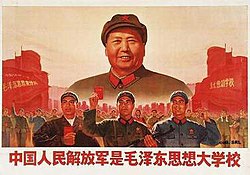 |
| A Cultural Revolution poster (Source: Wikipedia) |
(To be continued in Part 2)
Cheers
zhusun
Further reading:
Subscribe to:
Posts (Atom)