Monday, 24 June 2013

Star Wars Fans Rejoice!

Scheduled to be released in 2015, the new Star Wars instalment will the seventh in the saga that is already 36 years old.

Anyone up for Star Wars Mickey Mouse and Gang?
Rumoured to star the cast of the original Star Wars saga, Harrison Ford, Mark Hamill, Carrie Fisher and Anthony Daniels, just to name a few, who might reprise their roles as some of the most iconic characters in the Star Wars saga.

Whether or not you like Star Wars, its characters are well-known, and even those who have never seen the movie can imitate Darth Vader and his trademark low voice and heavy breathing. The new instalment, I think, will feature an aged Luke Skywalker and Leia Skywalker, and the much-loved C3PO.

Last year, it was announced that The Walt Disney Company had acquired LucasFilm for $4.05 billion. That, however, doesn't mean that George Lucas will not be involves in the production. He will, in fact, become the creative consultant. It is also said that Disney hopes to make Episodes 8 and 9. But we'll have to wait a few more years to see those.

Till then... May the force be with you!

Cheers
zhusun

Sunday, 12 May 2013

Scientists Echo the Gecko Feet

The gecko feet have gripped scientists - and countless surfaces with ease - for a long time and is one of the animals scientists are trying to mimic. I hope you like lizards!

A gecko's foot and a sheet of Geckskin
The invention in mind is the Geckskin. Named as one of the top scientific breakthroughs of 2012 by CNN Money, it is a truly gripping piece of biomimetic innovation. (Biomimetic, biomimicry or bionics means mimicking nature to design and engineer new man-made materials. Put another way, Geckskin is a biologically inspired design.)

From left: Al Crosby, Dan King, Michael Bartlett and Duncan Irschick
Background: Geckskin
The team behind this innovation is from the University of Massachusetts (UMass) Amherst. The team comprises Al Crosby, Dan King, Michael Bratlett and Duncan Irschick. The interdisciplinary team was not the first of scientists to develop adhesives from mimicking gecko footpads. What makes Geckskin different from other innovations is that it tries to mimic a different structure under the gecko feet, particularly the tendons. As explained by UMass researcher Al Crosby, the tendons are directly connected to the skin and hairs (called setae) on the gecko's footpad. The product is a sheet of adhesiv covered in these structures.

The Geckskin successfully emulates the gecko's feet. A sheet of gecksking the size of an idex card can hold up to 700 pounds and can be removed with minimal effort. What makes it even more practicable is that it is reusable and does not leave any residue behind when peeled off. I especially like the last listed feature, because I find adhesives such as cellophane tape a pain sometimes.

The reason why it was listed as the top 5 breakthroughs by CNN Money is because it is seen as extremely marketable. The research was also partially endorsed by US Defense Research Projestcs Agency. So there is a lot of potential for the Geckskin in application in all sorts of areas.

I'm guessing that the Geckskin might be used in outer space where super strong adhesives are needed to hold parts together - you wouldn't want vital pieces of equipment floating aimlessly around in space. Also, maybe in heavy industries and movie productions. It would definitely aide Tom Cruise's character in Mission Impossible, Ethan Hunt, on missions where climbing buildings is involved. Households consumers like us might even find use in this. We might need smaller versions that can be used to hold TVs up, maybe even to stick vases to the table - especially in households with hyperactive children running around. The additional helpful feature is that it won't leave a mark on your expensive crystal-ware.

Anybody up for making a Gecko-man? He could become Spiderman's buddy.

Cheers
zhusun

Further reading:
http://www.umass.edu/umhome/feature/little-lizard-could
http://news.cnet.com/8301-17938_105-57401164-1/the-holy-grail-of-adhesives/
http://www.umass.edu/loop/content/cnn-money-names-geckskin-top-science-breakthrough-2012
http://www.cns.umass.edu/about/newsletter/may-2012/inspired-by-gecko-feet-scientists-invent-super-adhesive-material
http://www.sciencedaily.com/releases/2012/02/120216165500.htm

Friday, 5 April 2013

Fabulous Fabiola

To some of you, the name might ring a bell, while to others, it's just anther play on words. To those who have been following updates and advances on arguably the most exciting scientific discovery of the decade, the first name in the title belongs to a woman, Fabiola Gianotti, whom as you'll find out, is no ordinary person.

The spectacular scientific discovery in mind is the discovery of a Higgs Boson - like particle. The Higgs Boson a.k.a God particle is named after the British physicist, Peter Higgs, who first proposed the 'Higgs Theory'. In mid 2012, a particle that has very similar properties with the Higgs particle was discovered in a collider at CERN. By the way, CERN stands for Conseil Europeen pour la Recherche Nucleaire, or European Council for Nuclear Research. 

Fabiola Gianotti
(Source: Time Magazine)
So where does Fabiola Gianotti come in? Well, she played an important role leading up to the discovery of the Higgs-like particle. She headed the ATLAS experiment - consisting of 3000 scientists from 37 countries - at the Large Hadron Collider (LHC) at CERN where the discovery was made. The ATLAS experiment was one of two experiments that were searching for signs of the Higgs Boson. In light of this, she was voted the runner-up person of the year 2012 in Time magazine.

Born to a geologist, Fabiola Gianotti is an Italian particle physicist by profession and was a physics coordinator at ATLAS from 1999 to 2003. After working at CERN for 18 years, she was elected to become spokesperson and coordinator of the ATLAS experiment. Surprisingly, Fabiola Gianotti's early education had little to do with physics. Her secondary education focused primarily on ancient languages, art history and literature.

Only during university did she opt to study physics. Having studied philosophy as a teenager, she says the two fields are very much alike as they both pondered on the very basic questions. Growing up, she had always been a very curious person and loved nature at the same time. So it seemed right that she pursued a filed which requires the hunger to know and understand all things around us.

Besides being a leading physicist, she also holds a professional music diploma in piano from the Milan Conservatory. Being well-immersed in both the arts and science, Gianotti thinks that art and physics are not so very different because, as she is quoted saying, 'art is based on very clear, mathematical principles like proportion and harmony. At the same time, physicists need to be inventive, to have ideas, to have some fantasy.'

That is something I agree on. I think art and science are very much related, except that the former is more abstract while the latter is more concrete and quantifiable. This has lead most of to think that art  or the arts is all about emotions, aesthetics, culture and creativity while science is often viewed as mathematical, absolute, and 'dead' even. Both fields are immensely broad, and intercept every now and then. Take architecture for example, it is considered a visual art yet employs mathematics and physics to design.

It is also interesting to note that female scientists only make up about 30% of the research scientist in Europe and a quarter in the US. That means it is more statistically unlikely for a woman to excel in a science career. Eventhough reports have shown that underachievement by girls in mathematics has narrowed drastically and is non-existent in some countries, girls typically lose interest in science very early on in secondary school and few want to pursue a science career. Some girls still believe they are not as good as boys in mathematics. However, Gianotti has proven that with passion and the right attitude, you can achieve just about anything. 

That should leave you with something to think about. For now, a round of applause for Fabiola Gianotti for her contributions in science and art, and for being curious.

Cheers
zhusun

Further reading:
http://poy.time.com/2012/12/19/runner-up-fabiola-gianotti-the-discoverer/
http://edition.cnn.com/2012/07/04/tech/physics-higgs-particle/index.html?hpt=hp_t1
http://en.wikipedia.org/wiki/Fabiola_Gianotti
http://edition.cnn.com/2012/07/03/business/fabiola-gianotti-leading-women

Friday, 29 March 2013

China, the Manufacturing Capital of the World... to-be (Part 4)

(Continued from Part 3)

Another point to remember is that China is an emerging economy whilst USA's is a developed economy. China is seen to 'emerge' because it is still in transition from a planned economy to a more market economy, and by doing so it has taken on economic reforms and policies that support development, as discussed in Parts 1 and 2.

Being an emerging market, China would receive more FDI than USA, and it is interesting to note that much of it comes from the USA, about $60.5 billion in 2010. USA, being a developed economy, would normally receive less transfers and FDIs - China's FDI in the USA was only $3.2 billion in 2010. Besides that, the population growth in China, most startlingly, was 0.48% compared to USA's 0.9% in 2012. Although the rate population growth is usually higher in developing and emerging economies, in China's case, I think it is urbanisation that really counts (discussed at the end of this paragraph). Lastly, the transition from an agricultural economy to a more industry and service based economy is still an ongoing process in China, with many millions from the rural areas in China migrating to urban areas every year, with a rate of 2.3% between 2010 to 2015.

Therefore, as of 2012, China remains the second largest economy in the world, not because it does not have the capacity to but because it is still emerging and transitioning. Some predict China will overtake the USA to become the largest economy in the world by the end of this year, while some say by 2015. Then there are also those who are worried about the Chinese economy imploding the way Japan's did about 2 decades ago. In my opinion, China's rise to become a leader in manufacturing seems inevitable, but for how long China can remain in the number 1 spot is anyone's bet.

Cheers
zhusun

Further reading:
https://www.cia.gov/library/publications/the-world-factbook/geos/us.html
https://www.cia.gov/library/publications/the-world-factbook/geos/ch.html
http://www.ustr.gov/countries-regions/china

China, the Manufacturing Capital of the World... to-be (Part 3)

(Continued from Part 2)

For 33 years since 1979, China had grown at an average of 9.9% a year. It is estimated that China's GDP expanded by 7.8% in 2012. China is also the largest exporter of goods to the USA, totaling $399.3 billion in 2011. Its exports in 2012 totaled $2.021 trillion and a labour force of 795.4 million. When talking about China, it seems that everything is in big proportions.

With all the impressive statistics, the title of this series of blog posts may be questionable, if not unsuitable. Coupled with the hype surrounding China's ability to become a manufacturing powerhouse in such a short time, it is easy to overlook other statistics.

It is important to remember that manufacturing in the USA is not, well, dead. With the advent of whole manufacturing communities becoming 'rust belts' since the 1980's, it is easy to assume that USA has grown out of the industry. But removing manufacturing from USA is near impossible. Some are talking about a revival in manufacturing. The cities leading in this revival include Seattle, Salt Lake City and Austin in Texas. Manufacturing in USA is still very much alive. Only, now the focus is directed more towards R&D and producing high value added products.

Last year, the real GDP growth of USA was only an estimated 2.2%. Compare that with China's growth, it is unenviable. However, economic growth rate is just one part of the comparison. There are other measures which would make the reason why China is not yet the largest economy and the manufacturing capital on earth.

Most noteworthy is the difference in Purchasing Power Parity (PPP) between China and USA. The definition of PPP provided by Investopedia, is the estimated amount of adjustment needed on the exchange of countries so that the exchange is equivalent to each county's purchasing power. Last year, China's PPP was $12.28 trillion while USA's was $15.66 trillion. Additionally, China's GDP in official exchange rate was $8.25 trillion while USA's was $15.65 trillion. Considering China's exchange rate is said to be very much depressed, $8.25 trillion is a lot! Hence, although China's manufacturing sector is expanding at an incredible rate, it still has not overtaken USA's.

(To be concluded in Part 4)

Cheers
zhusun

Further reading:
https://www.cia.gov/library/publications/the-world-factbook/geos/ch.html
https://www.cia.gov/library/publications/the-world-factbook/geos/us.html
http://www.investopedia.com/terms/p/ppp.asp
http://www.ustr.gov/countries-regions/china
http://www.forbes.com/sites/joelkotkin/2012/05/24/seattle-is-leading-an-american-manufacturing-revival/

Tuesday, 19 February 2013

China, the Manufacturing Capital of the World... to-be (Part 2)

(Continued from Part 1)

In 1978, China underwent widespread economic reforms. The government relaxed on investment policies, encouraged foreign investment and private-ownership. These reforms were initiated by the Communist Party of China, at the time time led by Deng Xiaoping. The reforms comprised of two stages. In the first stage, the government opened China up to foreign investment, encouraged more entrepreneurial activities by permitting more business start-ups and decollectivising agriculture. In the second stage, many state-owned industries were privatised, lifting of price controls and abolishing protectionist policies and regulations. The result of the economics reforms was a new economic climate which was more competitive, productive and dynamic.

Then came the time known as the 'readjustment period', from 1979 to 1981. Its agenda included stimulating agricultural production, expanding exports and overcoming logistics and electrical power issues. Policies were first introduced by the government experimentally on a small scale. If proven effective and successful then the policy would be applied on a large scale.

Farmers in China
(Source: http://english.people.com.cn/90002/95589/6512380.html)
In agriculture, an interesting policy called the 'contract responsibility system' or 'household contract responsibility system', that would allow farmers to own and work a small piece if land. The farmers were motivated to produce more and cut costs because they would keep the profits earned.

Besides that, policies that encouraged innovation and competition were also introduced to the industry. Enterprises could be collectively owned or individually owned, which was significant because during the Cultural Revolution, individual enterprises were almost non-existent.

Most importantly, foreign trade was very much encouraged. From easing foreign trade procedures to legalising interactions with foreign firms in China, systematic steps were taken to prepare China for the world stage once again. International trade would become a very important aspect in China's rise to become the manufacturing capital of the world.

(To be continued in Part 3)

Cheers
zhusun

Further reading:
http://en.wikipedia.org/wiki/Economic_history_of_the_People%27s_Republic_of_China#Reform_of_the_economic_system.2C_beginning_in_1978
http://english.cri.cn/3126/2008/10/31/53s419817.htm

Wednesday, 9 January 2013

China, the Manufacturing Capital of the World... to-be (Part 1)

America was once very much like China, the manufacturing power-house of the world. America's manufacturing sector enjoyed being the world's largest and the most advanced starting from the late 1890's, surpassing Britain. Some say the wars helped boost America's economy, especially after the Great Depression of the 1930's, due to higher production of uniforms, weaponry etc.

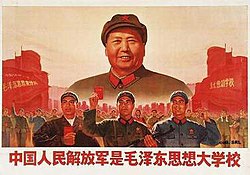
A Cultural Revolution poster
(Source: Wikipedia)
It was not until the late 1970's that America started off-shoring manufacturing jobs to counties such as China because that was when China started relaxing regulations and encouraged foreign investment. During that time, China was undergoing economic reforms to make it more efficient and stimulate higher economic growth. At this time, many people in China were still very poor and had dismal living  conditions. You could say that this low standard of living was due to the communist regime and the Cultural Revolution of 1966-76. The Cultural Revolution aimed to make China more communist and 'modern' but the effects were devastating as economic activities slowed and stopped. Therefore, it was important for China to have economic reforms to try to bring China out of an economic slumber.

(To be continued in Part 2)

Cheers
zhusun

Further reading: